Friday, August 27, 2021

My blind spot

Today was the all district professional development for the school district where I work.  The schedule said we would all meet in the auditorium for the morning to hear the keynote speaker.  Can you hear everyone's eyes rolling?  Whispers of "bring something to work on?" 

This was not that kind of keynote speaker.

Dr. Campbell was there to discuss something that we wanted to know.  How do we change the way we teach and lead to increase belonging (and test scores and graduation rates, etc) among our incredibly diverse school district (with a not so diverse faculty)?  The answer, of course, is a lot of hard work and soul searching.  Specific strategies include giving scholars a voice, using many different cultural references in the examples, questions, videos and books use in class, eliminating micro aggressions and normalizing conversations about race.

In Isabel Wilkerson's book, Caste: The Origins of Our Discontent, she compares the systems (including schools) in America to an old house.  There are always things that need to be fixed.  These needed repairs do not make the house useless, but they have to be done.  The longer the owners look away and pretend they aren't there, the more difficult they will be to fix later.  You didn't build the house, but you are living in it now.  What are you going to do about it?

For the last 50 years white people have been so busy saying that we weren't the ones who kept slaves, we weren't the ones who enacted Jim Crow laws, we've never burned a cross on anyone's lawn, why is it our problem?  It is time for us to acknowledge that we live in a house that needs some remodeling.  We weren't the ones who built it, but if we want to live in a nice house we have to accept the responsibility of making the repairs.

Toward the end of the presentation Dr. Campbell asked us to consider the way we were raised and what blind spots we may have as a result.  

As I listened to other participants share their blind spots I received inspiration for me.  As a white girl raised in a white conservative Christian bubble I was told over and over again that I was supposed to be an example for everyone else.  I was told that everyone was watching me to see what I would do.  Would I live the way I professed to believe?  There is doctrinal president for this.  Jesus said that his disciples should be a light on a hill for all the world to see.  He said that we should be the salt of the earth.  Paul admonished Timothy to "Be an example of the believers, in word and deed and conversation."  I was told endless stories of people who judged the church, for good or bad, based on one action of one person.  I internalized that to mean that the salvations of everyone I ever interacted with were somehow hanging on my perfect example.   It created anxiety and a twisted kind of belief that I should be able to be perfect.  That's a lot of stress for a kid, or anyone else, to carry around.  It leads to perfectionism which ultimately leads to self-condemnation because it is impossible to live up to such a standard.  There is doctrine here too.  Each person has their own agency.  Ultimately, everyone is responsible for their own decision whether to accept Jesus Christ or not.  We may help or hinder but we don't save or condemn anyone.  

How many of us educators went into our profession with the desire to save someone?  We tell stories of the teachers who inspired us when we were discouraged; the teachers who gave us a safe place when our homes didn't feel safe; the teachers who opened our eyes to our own potentials and introduced us to our passions.  We want to help.  We want to serve.  We want to give back what was given to us.  And we want to be remembered.  We also kind of want to be heroes.  This is a very general blanket statement and certainly doesn't apply to all education workers, but it's not uncommon either.  It's a special sort of pride that implies that I am somehow better; that if you will just let me show you a better way then you can be good like me.  From a Christian perspective this ends up looking a lot like self worship.  I can't save anyone, only Jesus can do that.  In fact, he already has.  He has already suffered the pains, sicknesses, unfairness, sin, everything for everyone of those kids.  They do not need fixing.  They are not broken.  They need to be heard, loved, taught, and respected just the way they are, because they are children of God, the same as us. Those are things that we, as educators (and parents), can and must do. 

Monday, August 23, 2021

Wisdom

 Last night I had a beautiful conversation with my daughter.  School starts tomorrow.  She's a senior and very nervous.  This is the wisdom she shared with me. "Social anxiety is a form of pride."  Wow!  That is kind of harsh, but so true.  What is the root of social anxiety?  Fear of looking stupid in front of other people.  Fear that someone might see you as less than perfect.  What right do we have to expect ourselves to be perfect?  Would we cast the same judgment on others that we cast on ourselves?  I guess sometimes we do, but that is pride too.  Perfection is in this same category.  We expect ourselves to be perfect all the time?  What kind of ridiculousness is that?  Only Jesus is perfect.  Only Jesus can make us perfect.  To imagine that I can make myself perfect is a form of self worship, idolatry.  Mistakes are part of the plan.  There is no salvation without the humility that says, "I make mistakes and that's ok.  It doesn't change my value and it doesn't disqualify me for love or salvation.  And I extend that same grace to everyone else too."

Take a risk.  Try something you know you might be really bad at.  Apologize when necessary and stop apologizing when it isn't.  Don't make excuses.  Learn to be comfortable with discomfort.  Be brave.  There is no courage without fear.  Fear and worry are not enemies to be avoided.  They are companions who remind us to be kind to the child in side us and and everyone else.  Mistakes are part of the plan.  Learn from them.  Work to correct them.  Offer love and grace, no matter what.

Tuesday, April 13, 2021

Learning About Racism Reading List

In the spring of 2020 I finally figured out that I could not just feel bad about racism any longer and I started reading:

The New Jim Crow, by Michelle Alexander

The Color of Compromise, by Jemar Tisby discusses the American Christian church's complicity in racism and suggests ways to combat it.

All American Boys, by Jason Reynolds and Brendan Kiely is a novel written from the perspective of two high school boys, one white and one black, and their experiences with police violence.

Becoming, by Michelle Obama

They Called Us Enemy, by George Takie and friends is a graphic novel about George's experience as a child in the Japanese internment camps during World War II.

How to be an Anti-Racist, by Ibram X. Kendi

Stamped: Racism, Anti-racism and You, by Ibram X. Kendi and Jason Reynolds, is "not" a history book about racism in America.

White Fragility: Why It's So Hard for White People to Talk About Racism, by Robin DiAngelo, is about how many white people see racism as the horrific things bad people do and unintentionally perpetuate racism through our fear of the word.

Parable of the Sower and Parable of the Talents, by Octavia Buttler, novels set in a dystopian society with a young black woman as the main protagonist.

And listening:

Code Switch with Shereen Marisol Meraji and Gene Demby, NPR

How to Citizen with Baratunde


To Read:

Courageous Conversations About Race by Glenn E Singleton, specifically written with educators in mind

Caste: The Origins of Our Discontent by Isabel Wilkerson "Ignorance is no protection from the consequences of inaction."

Thursday, April 1, 2021

Ike

 This story is as I remember my dad telling it to me on a bench by the Weber River walking path, summer 2019.  There were piles of cottonwood fluff everywhere.  Dad mentioned that it was super flammable.  I hadn't known that before.  My family was in Utah for a visit and some of my kids and I were walking with dad.  He had brain cancer but was doing pretty good, considering.  He walked slowly and needed to rest occasionally.  When we sat to rest I asked him to tell my kids about his dog, Ike.

My grandmother's aunt, Eva Willes Wangsgard, lived around the corner from where my dad grew up.  She was a poet with several published volumes and her name is listed among Utah poets of her time.  Eva also enjoyed entering contests.  In the 1950s and 60s it was common for newspapers and magazines to invite readers to submit entries for photo captions, jingles, poems, all sorts of things.  Prizes ranged from a basketball to large amounts of cash.  There was one common rule, only one entry per person.  This did not get in the way for Aunt Eva.  She would enter the contest as many times as she had nieces and nephews whose names she could borrow.  The family rule was that if the entry with your name on it won you could keep any prizes, but you had to split the money with Aunt Eva.

In the spring of 1955 "dad" submitted the winning entry to name a cartoon dog, he was 7.  The name Aunt Eva had submitted with dad's name on it was Bernard MuttSadden.  (This was a play on the name of Bernarr McFadden, a publisher and influencer in the areas of health and physical fitness.)  The prize was cash and a beagle. Dad had to go up on stage to receive the award.  He recalled his mother coaching him on what to say and "helping him remember" how he came up with the clever name.  

Dad liked Ike, but he wasn't too keen on taking care of him.  All the neighborhood kids liked to come over and play with Ike and apparently he was a good natured dog, but one day dad noticed that he was gone.  He figured he had run away and no-one ever said otherwise.

In October of 1999 my grandma passed away.  The family gathered in her home after the funeral and told the stories that reminded us of her.  Aunt Janet, my dad's older sister, mentioned Ike.  She looked a little nervous, but said that now that grandma was gone it was probably safe to finally tell dad the truth.  Grandma had gotten tired of taking care of Ike when dad didn't seem to care at all.  She found him a new home and gave him away.  About a week later dad noticed that Ike was gone and grandma told him he had run away.  Grandma had sworn Janet to secrecy for fear that dad would be angry and she carried that secret for over 40 years.  It might seam wrong to laugh that hard the day of your grandma's funeral but it was just what we all needed.  It was so like her, so funny, such a perfect finale.  

I sure miss grandma, and dad.  I wish I'd had a chance to know my great, great aunt Eva.

And remember, never give a pet to a child as a gift or a prize.

Wednesday, December 30, 2020

Cousin Ben


My dad had a cousin named Ben.  When they were boys they would fish and camp together.  Ben's mother, Echo, was my grandma's big sister.  She was like a second mom to grandma.  Aunt Echo had a knack for sewing.  According to Grandma she could see a dress in the store window then go home and make it.  Grandma needed a pattern, with instructions.  Sometimes she would get stuck and she'd ask Aunt Echo for help.  She'd show her the instructions and point out the spot where she got stuck and Echo would laugh and show her what to do.  Echo's husband, Uncle Brian, also made a strong impression on my grandma.  When Ben and his twin sister were born, Brian would get up in the night to help care for them.  He would say, "Well, Echo has to work all day too."  Meaning that the work she did all day to care for newborn twins and a toddler, a house, and whatever else she was responsible for was just as important has his job.  Grandma thought that was just amazing.  (I'm not sure what that says about my own grandpa but that's a story for another day.)  

When Ben and Dad graduated from high school they had to decide if they wanted to serve missions for the Church of Jesus Christ of Latter-day Saints.  Ben's mom and dad were both faithful, dedicated members of the church and he planned to serve a mission.  My grandma also faithfully attended church meetings but Grandpa had no use for church.  So dad was left to decide for himself.  He was a shy, anxious kid.  Church was boring.  He had no intention of serving a mission.  Before Ben left for his mission he had an opportunity to speak in church.  Dad and his mom and sister attended.  At some point in the talk Ben said something along the lines of "If I can serve a mission, so can you."  My father felt the Holy Spirit touch his heart and he knew that those words were for him.  He contacted his bishop and soon received a call to serve for two years in Japan.  

Dad's missionary service solidified his testimony of Jesus Christ and his determination to serve Him.  Throughout his life he diligently attended his church meetings, served in a variety of capacities in the church, and led his family in scripture reading, prayer and Family Home Evening.  He and Mom attended the temple often, nearly weekly for as long as I can remember.  On Sunday afternoons he would set up a card table and pull out all his genealogy papers.  He used a fountain pen to carefully copy his ancestor's information onto giant pedigree charts and family group records.  He was a faithful husband and father.

I was an adult living half way across the continent when my dad told me this story and I have often wondered if Ben ever knew the influence he had on my dad.  I can trace my own missionary service and devotion to Jesus Christ to the decision that Ben made to serve a mission.  I don't know where he served or how many people came to believe the gospel of Jesus Christ as a result of his service, but I know that I owe my own testimony to his decision to serve a mission, and his sharing of that choice with my dad.

Cousin Ben died a few months after my dad did.  (They both died during the 2020 COVID-19 pandemic but not from COVID.  Dad had brain cancer and Ben had a stroke.)  After learning of Ben's passing I carried an image in my mind of Dad and Ben tromping through the woods with their fishing poles; young, healthy, carefree.  Still best friends.

Alma 17:1-2 therefore, Alma did rejoice exceedingly to see his brethren; and what added more to his joy, they were still his brethren in the Lord...

This photo is of Ben straightening Dad's tie at my parents wedding reception.  Would that we all could have such a Best Man/Woman in our lives.

Monday, December 28, 2020

Christmas

When I was little my family had an unusual Christmas tree.  I wish I had a photo of it.  I expect my parents picked it up at the DI.* It came in a big square box.  The stand was broken and some of the branches were missing, so my parents would take out the tree, close the box flaps in a particular way and put the trunk of the tree through the hole in the center of the top of the box.  Then mom would wrap a white sheet around the box.  It kind of looked like a small tree sitting on a table top.  Kind of.  We had lights on the tree that looked like two inch globes dipped in colored rock salt.  There were tin ornaments shaped like birds and Santa and other things, reminiscent of the Victorian era.  But mostly the tree was covered in handmade ornaments that us kids brought home from Primary* and elementary school every year.  And there was an Angel.  She was an iridescent white cone with a head and some feathery wings.  I don't know where she came from but I remember my mother treating her very carefully.  She must have been important to her.

The recession of the late 1970s that propelled Ronald Reagan to the presidency was not good to my family.  Dad was unemployed for a while. My little sister, Elanor, was born with Down's syndrome.  She has always been an absolute joy and a lot of work, worry, and stress for my parents.  My Sandberg grandparents kept the freezer full of meat and the storage room full of home canned peaches.  My Hinchcliff grandparents provided bananas, store bought bread,* and powdered caked donuts with raspberry filling*.  And Christmas and birthday presents, school clothes, Easter dresses and I can only guess what else.  Grandma and Grandpa Hinchcliff lived nearby and we visited them often.  We loved to play in the basement where all the random things from the previous 50 years were kept.  Dress ups that my grandma had actually worn in the 60s, doll dresses stitched by hand for actual babies long since grown, endless piles of scratch paper left over from the middle school math and science classes my grandpa taught, and the giant electric train table kept us busy for hours.  But, after Thanksgiving the basement was off limits.  I don't remember ever really thinking about it, but obviously that's where all the gifts were stored.  There was one year when a crazy snow storm came through on Christmas Eve and my parents informed us that Santa was unable to get through and had, therefore, left all the presents at grandma's house.  We accepted that and happily enjoyed all of our Santa presents when we got to Grandma's.  I'm not sure it ever occurred to us that if Santa could get to Grandma's he could get to our house, it wasn't that far. I think I used a lot of willing suspension of disbelief as a kid.  I don't remember anyone telling me who Santa Claus really was, I just kind of always knew and didn't really think too hard about it.

That Christmas when dad was unemployed and Elanor was little must have been really hard for my parents.  We received regular food orders through the church (the raspberry jam was really good).  I don't remember understanding why, but I remember unpacking the boxes and being amazed at all the food.  As Christmas approached, strange things started happening.  One night there was a knock on the door and a man we didn't know stood on our porch with a giant bag.  He handed it to my parents, wished us Merry Christmas, and left.  The bag was filled with games.  Some of those games are still on the shelf in my mother's basement.  Another day the doorbell rang and there stood all the teenagers from our church with a beautiful Christmas tree.  A real Christmas tree, with matching handmade decorations.  They also had food and gifts.  When they placed the tree and plugged in the lights Elanor got so excited.  She was sitting on my mom's lap, waving both arms and legs in the air with the biggest, happiest smile I have ever seen.  I learned later that that experience, especially Elanor's reaction, was a truly meaningful experience for those teenagers.  They felt the joy of giving.  Maybe it was hard for my parents to accept all that help, but I could see the joy serving my family brought to the people standing on our porch.  It felt like Christmas every day for me.

*DI- Deseret Industries, a thrift store owned and operated by the Church of Jesus Christ of Latter-day Saints in Utah/Idaho/Arizona.  It is used for job training like Goodwill, as well as a place church leaders can go to get clothes and household goods for families and individuals in need.

*Primary- Sunday school for kids ages 3-11 in the Church of Jesus Christ of Latter-day Saints.

*My mom always made homemade bread.  I didn't really like it.  The crust was thick and tough and it didn't make very good sandwiches.  The bread would crumble to bits.  I remember one day some friends were over and going crazy about having homemade bread.  It was the first time I remember realizing that homemade bread was special.  I've learned to appreciate homemade bread since then, but I still don't prefer is for sandwiches.

*They don't sell those in Michigan.  We got some last time we were in Utah and they were good but not as good as I remember.  Maybe they changed the recipe.  Ya, that's it.  We didn't eat a lot of treats so the treats grandma brought were well appreciated.

Wednesday, December 2, 2020

Walking With Dad


When I was a little girl I loved to walk with my dad.  We would walk around the block and talk to the neighbors, the Stevens', the Singelton's.  I loved to hold his hand and try to match his strides.  When he noticed he would take longer and longer strides until I was leaping with every step, until I was laughing too hard to keep up.  

We would often spend the afternoon at my grandmother's house.  One day we were getting ready to go home and I was certain that I should be the one to ride in the coveted center front seat between my parents but my sister had beat me to it.  My child's mind believed it had well thought out reasoning but no-one was interested in hearing it.  Looking back as an adult and a mother I can imagine that my little sisters were tired and my parents were anxious to get home.  I made a fuss.  The thing I really remember is feeling unheard.  And I was a stubborn kid.  Finally in a moment of desperation, or inspiration, my dad handed my mom the car keys, took me by the hand and started walking.  It was almost 6 miles and late in the afternoon.  We walked and we talked.  We walked a different way than I had ever been before.  Maybe to avoid the big down and up again hill that we called "the roller coaster".  It was fun in the car, not so much on foot.  The thing I really remember is feeling heard and feeling loved.  I don't remember being tired although I'm sure I was.  I remember it was dark before we got home.  My father's decision to walk with me became one of my most cherished memories.  

Soon after that my dad decided I was ready to climb a mountain.  Early on a Saturday morning, my dad, my older sister, Oretta, and I filled our canteens and packed our bags.  We drove up the canyon to the parking lot of the Snow Basin ski resort.  We started walking up the dirt service road that follows the ski lifts.  We walked for a long time.  We passed pine trees and quaking aspens, streams and fields of wild flowers.  I remember putting my handkerchief in the stream and wiping my face with the frigid water.  It was a hot sunny day and I got tired quickly.  

When I wanted to rest, dad would point to a shady spot up ahead and encourage me to get that far before we stopped.  Somehow I found that I did have enough strength to go that far.  After a rest and a drink of water I discovered that I wasn't so tired as I thought and I could cary on.  Dad was endlessly patient with us, encouraging us to go "just a little further."  About noon we reached the saddle, a low spot between two peaks where we could look over the ridge to the other side.  I thought we were done, we made it, but dad pointed up to the peak just above us.  We were close but the final stretch was steep and rocky and I didn't think I had any more strength left.  Somehow dad convinced me to keep going and it turns out I did have enough strength to get to the very top of Mt. Ogden. 

It is hard to describe the way I felt standing on the peak.  Even the wind feels different.  I felt like I could see forever.  To the west was the city of Ogden where we lived.  I could see the Ogden Temple and other land marks I recognized.  I could see all the way to the far side of the Great Salt Lake.  To the east was row upon row of mountain peaks finally fading into the sky.  I felt an overwhelming awe as I surveyed the vastness of God's creations.  I felt the contradiction of being so infinitesimally small and so strong simultaneously.  I started to understand my own value and my own weakness at the same time.  It was my first glimpse into eternity.  

So many times since then I have felt that I was done, that I had nothing left to give.  Every time I have found that I do have more.  I can push forward to the next shady spot with a log or a rock to sit on.  I can take a break and drink some water and find that I do have the strength to cary on after all.  

We ate our lunch and took pictures with my Kodak Disk camera.  We signed the registry and started back down.  Down was much easier than up.  When I went back to school that fall I pointed out Mt. Ogden to my friends and told them all how I had been to the very top.  

Last summer I went for a walk with my dad.  He had been diagnosed with brain cancer but the treatments were going well and dad was feeling pretty good.  I had hoped to climb Mt. Ogden that summer but it was too early and the snow was still deep, so we went out to Antelope Island instead.  Dad wanted to come along.  Dad and I and a couple of the kids walked along the shoreline trail.  It was flat and easy.  We went slow.  I kept checking if dad was ready to turn around.  He kept saying, "No, I want to see what's over that rise."  So we kept walking.  He was a little bit wobbly and I was terrified he would fall.  We walked so far that we ended up having to ask some strangers for a ride back to the car. It was weird and a little embarrassing, but they were kind and everything was fine in the end.  That was the last time I walked with my dad.  

When we visited at Christmas he could barely walk from the kitchen to the living room.  In January he fell and broke his arm.  He spent a few days in the hospital, a few weeks in the rehabilitation center, and then to a nursing home because he couldn't even get out of bed without help.  In March the world shut down for the COVID-19 pandemic and in April he was gone.  It was still dangerous to travel and a funeral was out of the question.  The funeral home streamed the graveside service over Facebook.  That was really weird.

This summer, more than 35 years later, I returned to the top of Mt. Ogden, this time with my own children in tow.  I encouraged them to go just a little bit further, to take a break and then try again.  I was afraid we wouldn't make it to the top.  But we did, all of us.  We sat on the peak and looked at the world just as I did when I was 10.  It's a little different now.  The ski resort got a facelift for the Utah Olympics a few years ago.  There's a helicopter pad at the top now, more satellite dishes, too.  

My feet hurt and we still had the long walk back down, but I could feel the wind as it blew and see the long lines of peaks fading into the distance.  My children were there at the top of the mountain and I prayed that they felt eternity and their own strength the way I did when I stood on top of that mountain with my dad so long ago.

Thursday, April 2, 2020

Saving the World: Part 2, Social Distancing Style

I am writing this post in April of 2020.  We've been home from everything for almost three weeks and we are a little crazy.  One of the first things I realized when school closed was that we were still going to need to get out of the house every day or we weren't all going to survive, virus or no virus.  We started going for walks.  March is when the snow melts in Michigan and the freshly melted snow leaves behind six months worth of road side trash.  It can be downright impressive.  By the end of April nature has hidden it all away for another season but in March and early April it is there for all to see.
My husband likes to take long runs every day and as he runs he notices the trash.  This spot is about a mile from our house and seams to be a hot spot for trash.  So one day we put a couple of trash bags and gloves in our pockets and went for a walk.  It took almost no time to fill two large trash bags and a very old cooler as full as we could carry them.  One lady running by said Thank you. That was when we realized we hadn't worked out how we were going to get the trash back home.  We made like the trash Santa and carried the bags toward home until we came upon a dumpster and decided it would be ethical to put the bags in it.  (My apologies to the offices if it wasn't.  But, really, how much easier could it be to help save the world than donating a little dumpster space?)


After that we started putting a couple of (smaller) trash bags in our pockets every time we left the house.  The thing I have noticed most is that there is more trash than we can possibly pick up.  It seams to collect near roads and parking lots and, oddly enough, around trash cans.  The lady walking her dog was impressed: "Are you guys picking up trash?!?  I always think I should, but I never do."


West Michigan is a little shy on sunshine.  (I once had a doctor suggest that everyone living in West Michigan should take vitamin D supplements.)  So whenever the sun shows it's cold little face we drag the kids out for a walk.  We wear our coats, clean up trash, soak up whatever sun there is, get a little exercise, remember that there are other people in the world.  (They are all out trying to stay sane, too.  From six feet away, of course.)


It reminds me that I do, in fact, still belong to a community.  And I can still contribute to that community, even from a six foot distance.

The skunk cabbage was in bloom.  Did you know that skunk cabbage grows down into the ground instead of up into the air like most plants?  An old skunk cabbage is almost impossible to dig up because its stem goes so far down into the mud.  Crazy.

Monday, March 16, 2020

Saving the World: Part 1, Compost

Compost is about as un-sexy as anything comes, but my family makes a lot of fruit and vegetable scraps and my yard makes a lot of weeds so it seamed like a good place to start.
We have had a compost bin for years, but it needed some repairs and I thought we could do better with a little more information.

So I ordered a bunch of books from the library and tried to read them. The kid's books were easy to read but didn't give me any new information.  The adult books varied from easy to long but I still don't know what to do about the winter.  (Stuff doesn't compost when it's freezing outside.). We'll worry about that later.

One thing I have learned over the years is that most projects happen when you learn a little bit then just try it.  You try it for a while, learn a little bit more, try it a little differently, fail a little bit, succeed a little bit, learn a little more, tweak, try again.  Pretty much everything I know how to do is the result of that formula right there.

There appear to be about a thousand different ways to build a compost bin.  Many available commercially.  Many different styles to build.  They all have holes to allow air circulation and most are open on the bottom to encourage the little buggies to come hang out.


We used cedar fencing to build a three bin system.  One bin is where we put all those fruit and vegetable scraps and yard waste.  The center bin is full of leaves that can be layered with the fresh stuff.  The last bin is full of last year's half composted compost.  The idea of having the separate bins is that you have compost when you need it without having to sort out the not quite done bits.  If all goes well we will empty out last year's bin over the summer and switch to adding things there while this year's bin finishes up next spring.


Things a compost bin needs: air, water, green stuff and brown stuff, worms and bugs.
Air: The bin should not be air tight and the compost should get stirred up regularly to allow oxygen into the mix.  The more often you stir it the faster it turns to compost and the less it stinks.  Oxygen is our friend.
Water: The compost should be damp, not wet. If you live in a wet climate you'll need to protect from too much water, if you live in a dry climate you will need to water it occasionally.
Green Stuff: That's the fruit and veggie scraps from the kitchen, lawn clippings, garden waste, etc.
Brown Stuff: Dry leaves, mulch, etc.
Worms and Bugs: Millions of microscopic bacteria, fungi, earthworms, and lots of other bugs.  You don't have to go find these guys.  The compost is like a big old "Diner" sign.  If you build it they will come.

So all you have to do is layer the green stuff and the brown stuff, make sure it stays the right amount wet and stir it regularly.  Once or twice a week seams like the consensus. But apparently you can never stir it and still get compost. (That's what we've been doing so far.) It just takes a lot longer.

Next Big Problem: With the compost bin behind the garage the chances that anyone (even me) will run out there every evening to empty the day's scraps becomes very small.  So we added an intermediary step.  Not always a good idea but, we decided, worth trying.

The big bucket will live just outside the kitchen door.  It has a lid to keep out the critters and holes to let the air in and the juice out.  It will get emptied as part of the weekly lawn mowing.  (We are very optimistic.)


Here's the plan: We have a small bucket on the kitchen counter.  When you eat an apple you drop the core in the little bucket.  (See how optimistic we are?)


Every day someone (we are thinking positive here and imagine that it could be anyone living here) empties the little bucket into the big green bucket with a lid.


When someone (still thinking positive here) mows the lawn they will use the pitch fork to stir the compost, empty the grass clippings and the green bucket into the compost bin, throw a layer of dry leaves on top and voila it all happily composts until next time.


 So here's hoping we learned a little and will have a little better compost experience than we have in the past.  (And still thinking positive that we will do a good job getting those scraps off the counter, into the compost and stirred occasionally.)

Books I read for this project:
Kids Books:
Way to Grow! Gardening: Composting by Rebecca Pettiford
Published by Pogo, 2016 (Early Elementary)
Really Rotten Truth About Composting by Jodie Mangor
Published by Rourke (Late Elementary)

Books for Grown Ups:
Basic Composting by Eric Ebeling and friends
Published by Stackpole Books, 2003 (Short, with lots of pictures)
Compost City: Practical Composting Know-how for Small-space Living by Rebecca Louie
Published by Roost Books, 2015 (Long, with lots of information and a dry sense of humor.)

And a moment of real...

Remember this picture of my cute little compost bucket on my nice clean countertop?


Well, if you zoom out just a little this is what you see.  Just didn't want anyone to feel bad.


Thursday, August 29, 2019

10 Minutes

I was with several friends, waiting for our kids the other day and they agreed to help me make a list of things to do in 10 minutes or less that help me feel positive and don't include staring blankly at my phone. Ironic to post it here, but thought it would be fun to share.
Play a musical instrument (guitar, piano, etc.)
Play the kazoo (requires no talent or skill)
Call someone to check in (short conversation, "I had ten minutes and wanted to check in with you...")
Yoga
Empty the dishwasher
Sweep the floor
Read a scripture
Write a thank you
Read an Ensign article (or whatever magazine you have lying around)
Plan a date (with significant other or child)
Clean out your purse (you might find a treasure)
Knit/crochet
Listen to a podcast
Read a chapter from a book you want to read
Weed the garden
Purge old emails
Do push-ups, sit-ups, etc
Stretch
Draw a picture
Walk
Get a drink of water
Dead head flowers
Go for a bike ride
Make something that you bought the stuff for but never got around to yet (It's ok to stop half done and come back to it next...year, or whenever, you know, it's not going anywhere, but at least it will be started.)
Make a play list
Chop vegetables for dinner
Make a treat
Shovel/rake leaves for a neighbor
Decorate for a holiday (whatever holiday you want, who cares which one is coming up next)
Plan next year's garden (no pressure, it's just hypothetical)
Make a list (to do, to buy, fun things to do, favorite ice cream flavors...)
Write (personal history moment, journal, letter, thoughts, whatever)
Rearrange the furniture
Index
Family history
Any other ideas?

Tuesday, May 8, 2018

A Contrast and a Comparison (or, Life is Like a Band Rehearsal)


I love band.  I have since I was 12 years old and made my very first sound on a Euphonium.  
It is my first love, it is what got me through high school and it is what I studied at college.  
I have spent many, many hours in rehearsals.  I have had many different conductors.
I like band so much I make my friends and family play with me whenever possible.
This is a band put together for a church picnic made up of anyone who could hold an instrument.
That's me on the far right, my son on trombone next to me and my husband on tuba.
As a freshman in college I played under a conductor who was also brand new to the school.  He was young, friendly, and an amazing musician, but his rehearsals were unbearably tedious.  
Often we would be working on a new piece of music when he would notice that the flutes or clarinets (it was always the flutes or clarinets) were struggling with a difficult section where they had to play a lot of notes in a very short amount of time.  He would stop and ask them to play the section alone.  It would become obvious that it needed some work, so he would take some time to work on it, sometimes as much as 20 or even 30 minutes.  

Trombone players are not good at sitting and waiting.  
(They are a little bit like 2-year olds, only sneakier.)  
Trumpet players are also not very good at sitting and waiting.  
(They really like to be important.)  
Tuba players get comfortable and are soon snoring softly (or loudly). 


This conductor also had a tendency to stop whenever anything wasn't perfect, and well, we weren't very perfect.  This meant that we often found ourselves on stage preparing to play a song through from beginning to end for the very first time in front of an audience.  
Usually, it was fine.  
We were college musicians, after all.  
Sometimes it was not fine.  
We were, after all, just college musicians.*

In contrast, I currently find myself playing with the West Michigan New Horizons Music Ensembles Symphonic Band under the direction of Dr. Nancy Summers.

I have been playing with the New Horizons Band for about five years now
and I enjoy the rehearsals very much.  
Sometimes when we are learning a new piece of music Nancy will notice that the flutes or clarinets are struggling with a difficult section where they have to play a lot of notes in a very short amount to time.  She will stop and ask them to play the section alone.  It will become obvious that it needs some work so she will ask them to work on it at home over the coming week.  She may give them some pointers about how to practice it effectively and then we move on.  At the next rehearsal we will cover that spot again, perhaps another minute or two of help and some encouragement to keep working on it and just as the trombone players are wondering if they can get away with something 
we are all back in.


Nancy notices whenever something isn't perfect, and believe me, we are not perfect.  
(She is often jotting down notes for future rehearsals.)  
But we never find ourselves on stage preparing to play a song through for the first time.  She makes sure that we spend some of our time in rehearsal running our pieces 
from top to bottom, no matter what!  
This can get very interesting, but far more often it is surprisingly empowering.  
"Did you notice how we got it back together after that near train wreck?"
Sometimes our most moving musical experiences happen during rehearsal.  
It's a shame to miss the glorious musical moments just because they happen in a rehearsal.
Not only is this helpful when performance time comes, 
but it is amazing how satisfying it makes a rehearsal feel.  
Music is funny that way.  Try listening to the first half of a song and then go on with the rest of the day.  It leaves a strangely unsettled feeling, like stopping mid-sentence, or wearing one shoe.  


Now for the Comparison.  
I know you are on pins and needles to know how life is like a band rehearsal.  
Well, here it is: If we spend all our time focusing on one little issue that we find particularly difficult we will find ourselves unsatisfied and unhappy.  

Everyone has something that is hard.  
For flutes and clarinets it is those inevitable sixteenth-note runs.
For tubas it is not getting lost during those endless oom-pahs and then missing the interesting parts. 
 For me it is using my time effectively.
For you it may be something completely different.  
I know that I need to work on my faults.  This isn't permission to ignore them completely.  
There are certainly times when a full on Stop and Fix is in order.
However, it is permission to live the whole day, clear through, stopping only briefly, here and there to look at the difficult spots and plan how to work on them, then moving on.  
Don't quit every time something isn't perfect.  
Push through.  Make a plan. 
Come back to it, but don't dwell on it.

Glorious moments happen all around us, all the time, while we are just living our lives.
The "rehearsal" days of our lives can be fun, creative and satisfying.
Don't put off living for the "performance" days.


 *That particular professor did one amazing thing that I think very few professors actually do. He  read the student evaluations we were encouraged to complete every semester.  Over time his rehearsals became much more pleasant and our band improved dramatically.  (That is a good topic for another post some other day.)

Wednesday, May 17, 2017

Climb On!

This is me...rock climbing.
For a middle aged, slightly over weight, mother of six, I'm looking pretty good on that wall.  You might even be tempted to be impressed.  (And maybe the fact that I was willing to put on the harness at all is impressive, but all the kids were watching, I had no choice.)

There are a few things you should know before you get too impressed.

  • There is a rope.  If you look closely you can see it.  There were moments when that rope did more than just keep me from falling.  Sometimes it gave me a little boost.
  • There was a belayer.  In this case it happened to be my husband.  The rope isn't much good without the belayer.  Not only did he make sure I didn't fall, and give me a couple of boosts, he also gave me instructions about where to find handholds and a lot of encouragement.
  • The person who took the photo (maybe it was my sister or maybe my son, I'm not sure) was kind enough to take it from the side, not the back.  I have some pretty awful photos of people's backsides while climbing.  It is not flattering.  Thank you for making me look good.
  • The bottom of the photo is about 2 feet above the ground.  That was as far as I got.  I'm not much of a rock climber yet.  I may never be.  My husband and some of my kids love it and I am happy to support them in that hobby.  I'll even put on the harness and try an occasional climb.  If nothing else it makes everyone else feel better about their own attempts.
It is so easy to look at a snapshot of someone else's life and make assumptions that may not be true.  You may not see all of the help they have received from family and friends.  You may not realize that you are only seeing the carefully orchestrated photo shoot.  Taken from a different angle it may be a whole different picture.  

It is ok to have a harness, a rope, a helmet, and a belayer in your life.  In fact, we'd really struggle to get anywhere without them.  And even if you feel like you can only get a few feet off the ground, don't discount the value of the attempt, and the example to those who are watching.
Climb On!

Wednesday, April 26, 2017

Habitat for Humanity

I have always wanted to work on a Habitat for Humanity house.  It just always seemed really cool.
But I'm busy and I didn't really know how to sign up and don't you have to go as a group and... so I never did.  You know how it is.  Good thing there are people our there who do stuff anyway, like my daughter's National Honor Society advisor.  She set up a day for the 12th grade Honor Society students to volunteer for Habitat for Humanity.  And she needed adults to come along.  She emailed me personally and asked if I would be willing.  I rearranged my schedule.

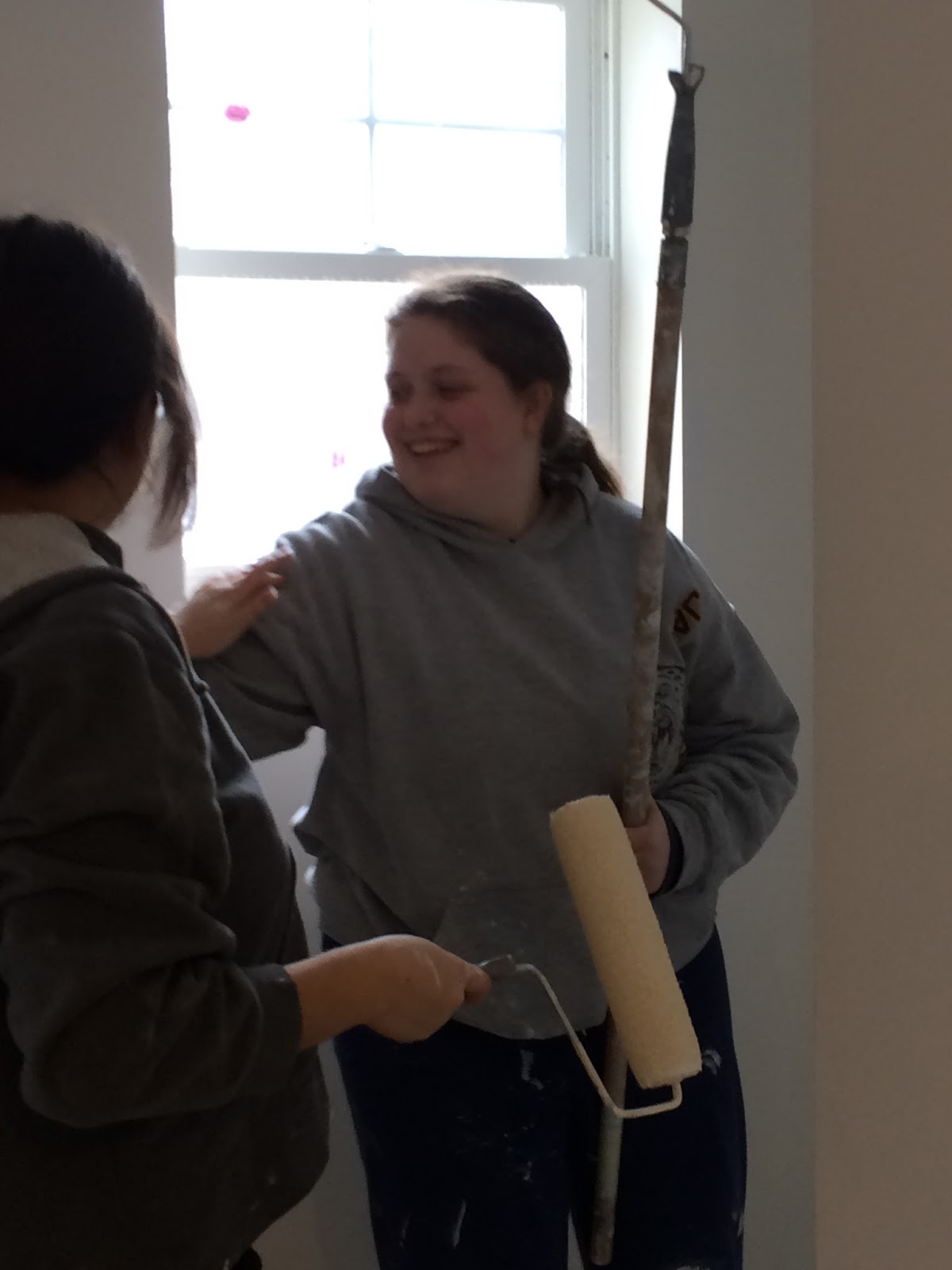
My group spent the day painting the inside of a house.  (We were really glad we got that assignment because it was about 10 degrees that day.  Some of the other groups spent the day working outside.  Brrr.)  The lady from Habitat was so nice and so helpful.  She explained everything so clearly.  (Several of the kids had never painted anything.)  And she explained Habitat's mission in a way that made so much sense.  (Did you know that the owners are required to put in a lot of hours helping build the house?  There are two reasons for this, one, it gives them a sense of ownership of the house, and two, it teaches them the skills they need to maintain the house.  They know how to put up a shelf, paint a wall, fix a hole, replace a light fixture, etc.  Brilliant.)  The kids and I worked hard and we painted the whole house.  We felt like we accomplished something and we had a good time.

I was impressed with this group of kids.  There were about 10 in my group.  They were pretty evenly split between African-American, Asian, Hispanic and Caucasian.  Several were children of immigrants and several were immigrants themselves.  They were all members of the National Honor Society which means that they have maintained a GPA of 3.6 or higher throughout high school and committed to providing service for their communities.  All of them are planning to attend college and major on a variety of fields from medicine to archeology to environmental science.  And some are still undecided.  That's ok, too.  (Nearly everyone changes their major at least once anyway.)  None are wealthy, all have had to work hard and make sacrifices.  They are smart and kind and they really don't care what country you come from, what color your skin is, or whether you speak with an accent.  They care about how hard you are willing to work and how you choose to treat other people.  

I'm looking forward to another day with Habitat and meeting some more amazing service minded people.

I'm back.


It is OK to miss a few weeks on the blog.
Some months are harder than others.

Wednesday, March 22, 2017

Getting to Eagle

The Eagle Scout Project
or "It is ok to let a 14 year old lead."


The mission of the Boy Scouts of America is to prepare young people to make ethical and moral choices over their lifetimes by instilling in them the values of the Scout Oath and Law.

On my honor I will do my best
To do my duty to God and my country
and to obey the Scout Law;
To help other people at all times;
To keep myself physically strong,
mentally awake, and morally straight.

This is why I support the Boy Scouts of America.  This is why I give my time, money, energy, and my husband's time to the Boy Scouts.  This is who and what I want my son to be.

When Thomas achieved the rank of Life Scout and began thinking about his Eagle Project he struggled to know what to do.  He thought he had an idea to build a bridge at a local park but there were some complications that nixed that project.  While driving in the car I asked him to think about who he wanted to serve.  (Proud mom moment here.)  He started listing the most vulnerable members of the population: the homeless, victims of domestic violence, refugees, etc.  
As part of my responsibilities with my church women's group I had recently started a conversation with a local organization that serves refugees.  I gave my son the contact information and then helped him make the initial phone call.  

Here is the hardest part of helping your son earn an Eagle Scout award.  Letting him lead.  I cannot tell you the number of times I had to bite my tongue, or walk away.  My mantra: "It is ok if this activity looks like a 14 year old is leading."  The whole point of the Eagle project is for the boy to practice the leadership skills he has learned in scouts.  That is not to say that my husband and I didn't help.  We helped a lot.  But we worked hard to make sure that Thomas did everything that he needed to do to be able to say in the end, "This was my project and I did it."

Tom's project benefited an organization called Samaritas.  One of the things Samaritas does is sponsor refugees arriving in America.  They provide refugees with apartments, furniture, clothes, medical care, education, English classes, and help finding a job.  They serve these families for 3-6 months and then the family is on their own.  It is truly amazing.

They have a small warehouse space where they store home furnishings that have been donated until they are needed by a refugee family.  It was a mess.  More than anything they needed some shelves.  Thomas set up a GoFundMe account to raise money to buy used industrial shelving.  Then he organized a day of service for his scout troop.  He also invited our church friends and his old Cub Scout Pack to join us.  We spent the morning putting together shelves and clothing racks.  Then we filled them up.  It was a great day.  


It is ok to let the 14 year old lead.  
It might even be AMAZING!